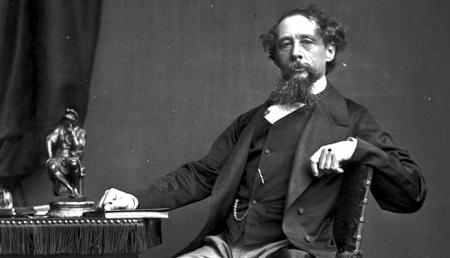
De estenógrafo judicial até se tornar uma das mais importantes figuras da literatura universal. Pelo caminho, Charles Dickens teve tempo, também, para se devotar ao jornalismo. No 150º aniversário da sua morte – que ocorreu em 9 de junho de 1870 – reclamamos, em termos jornalísticos, um dos grandes escritores britânicos. (Karen Montero)
Charles Dickens (Portsmouth, UK, 1812) was one of the best working-class portraitists of nineteenth-century London but was also a chronicler and editor of various British newspapers such as The Daily News . From fiction and non-fiction [1] , he always found exciting topics for which to investigate on the other side of the English capital. Nothing he wrote, no matter how much he did it almost two hundred years ago, is out of date. He himself, when he was already a renowned writer, acknowledged at a conference in the United States that his success was due to “the incredible training of work in different newspapers when he was very young.”
“It’s vivid and immediate, beautifully written, full of wit and satire, but it avoids all its pitfalls in overly elaborate plot novels and sentimentality,” said John Drew about his preference for Dickens’s journalistic production in the inauguration of the exhibition Disturbing Shadows that in 2017 hosted the Charles Dickens Museum in London.
The exhibition, curated by Drew himself, covered the writer’s side as a chronicler for various newspapers and magazines of the time. They could be found from little-known articles by Dickens to handwritten letters and the wooden cane he used in the last years of his life. Drew claimed that “it was impossible to separate the journalist Dickens from the writer”, a fact that can be transferred, for example, to novels such as Nicholas Nickleby , where there is a very strong social component.
Drew is also the author of the book Dickens The Journalist , which reviews the career of the author of Oliver Twist in search of news and investigates which topics interested him most. As a teenager, Dickens began his career working as a parliamentary columnist for The Mirror of Parliament , founded by his uncle John Barrow, where he spent four years writing about Westminster. In the midst of the Victorian era, then, he witnessed important political changes. And it is that in the House of Commons it witnessed debates on the Law of the Reform, the extension of the suffrage or the readjustment of the electoral districts, among others.
Terrible working conditions
Dickens ended up being recognized as one of the most accurate and documented reporters of the time. One factor that played in his favor was his previous job as a stenographer. His mastery of shorthand allowed him to accurately record the speeches of politicians. In addition, he had to work from the last bench reserved for visitors, where he took even more courage to have the ability to pick up the precise words of the deputies.
“I wrote on my knees in the old row behind the old gallery of the House of Commons; and I wrote standing up to write in an absurd pen in the old House of Lords, where we used to be piled up like sheep, ”Dickens acknowledged years later in a speech to the Journalistic Press Fund. Other journalistic sources of the time speak of those benches as a sinister place, as there was very little light – it was almost impossible to read – and the ventilation, scarce, caused an unpleasant force that permeated the space.
Pioneer of investigative journalism
Despite those drawbacks, Dickens excelled in his role as a parliamentary reporter. And, as Andrew Sparrows, a journalist for The Guardian , explains in the book Obscure Scribblers (Politico’s, 2003) – where he reviews three hundred years of history of journalistic coverage in Westminster – Dickens was not impressed by the pomposity of politicians or his excessive rhetoric.
A few years later, he continued his career in The Morning Chronicle , a liberal newspaper, and also collaborated with The True Sun , a radical, evening newspaper. A few years as a journalist, in which he himself founded three weekly magazines such as Master Humphrey’s Clock (1840), Household Words (1850) and All the Year Round (1859).
Another aspect to consider in Dickens’s journalistic work is his journalism of denunciation that he practiced and that made him a pioneer of investigative journalism to the point that Karl Marx himself admitted that the famous writer British “had proclaimed more truths of great social and political importance than all the speeches of political professionals, agitators and moralists put together.”
That well-known journalistic career, however, began to alternate with the literary one – he published his novels for deliveries to the press – until his facet as a writer ended up being so successful that he had to leave that of journalist as a main job, despite maintaining some collaborations.
Intertwined profiles
The time he worked in the press sector, then, is key as learning to write and to describing events. Given Dickens ’journalistic past, novels like Oliver Twist or David Copperfield take on a new meaning. And it is that the detail by the personalities of the personages, the interest by the low bottoms of the English capital or the autobiographical base to David Copperfield of the same writer are key aspects to understand their entailment to the media.
While Dickens has gone down in history as the literary reference of the Victorian era, it is inevitable to link his journalistic profile to the literary. In fact, throughout his life he combined both jobs until his death at the age of 54 due to a stroke in the British town of Gadshill Place. It is clear, then, that Dickens’s literary legacy probably would not have been the same without the journalistic pen.
(Report)